
Scroll through any popular digital fashion platform today, and you’ll immediately notice a visual language that dominates avatar catalogs, loading screens, and community feeds. Anime aesthetics are no longer confined to streaming services or niche convention halls. They have quietly become the foundational style framework for modern dress-up games, especially among Gen Z and the massive Roblox player base that logs millions of daily active sessions. These players aren’t just clicking through menus; they’re curating digital identities using highly stylized, narrative-rich customization tools that mirror the visual storytelling they grew up consuming.
At their core, dress-up games are interactive digital wardrobes where players experiment with clothing, accessories, and character styling without real-world consequences. Anime, as both a visual medium and cultural movement, brings a distinct toolkit to that space. It offers exaggerated proportions, emotionally expressive features, and a deeply layered history of fashion subcultures that translate seamlessly into interactive design. When combined, these elements create an ecosystem where players don’t just dress up—they perform, role-play, and participate in a shared digital culture.
This article explores how anime has fundamentally reshaped the dress-up gaming landscape. We’ll break down the impact of anime aesthetics on character design, examine how narrative tropes drive gameplay loops, and analyze the economic engines that keep these communities engaged. For digital marketers, content creators, and game developers, understanding this crossover isn’t just trendy—it’s a blueprint for user retention, community growth, and virtual economy optimization. If you’ve been tracking virtual fashion trends, this is the blueprint you’ve been waiting for.
Visual Aesthetics and Character Design
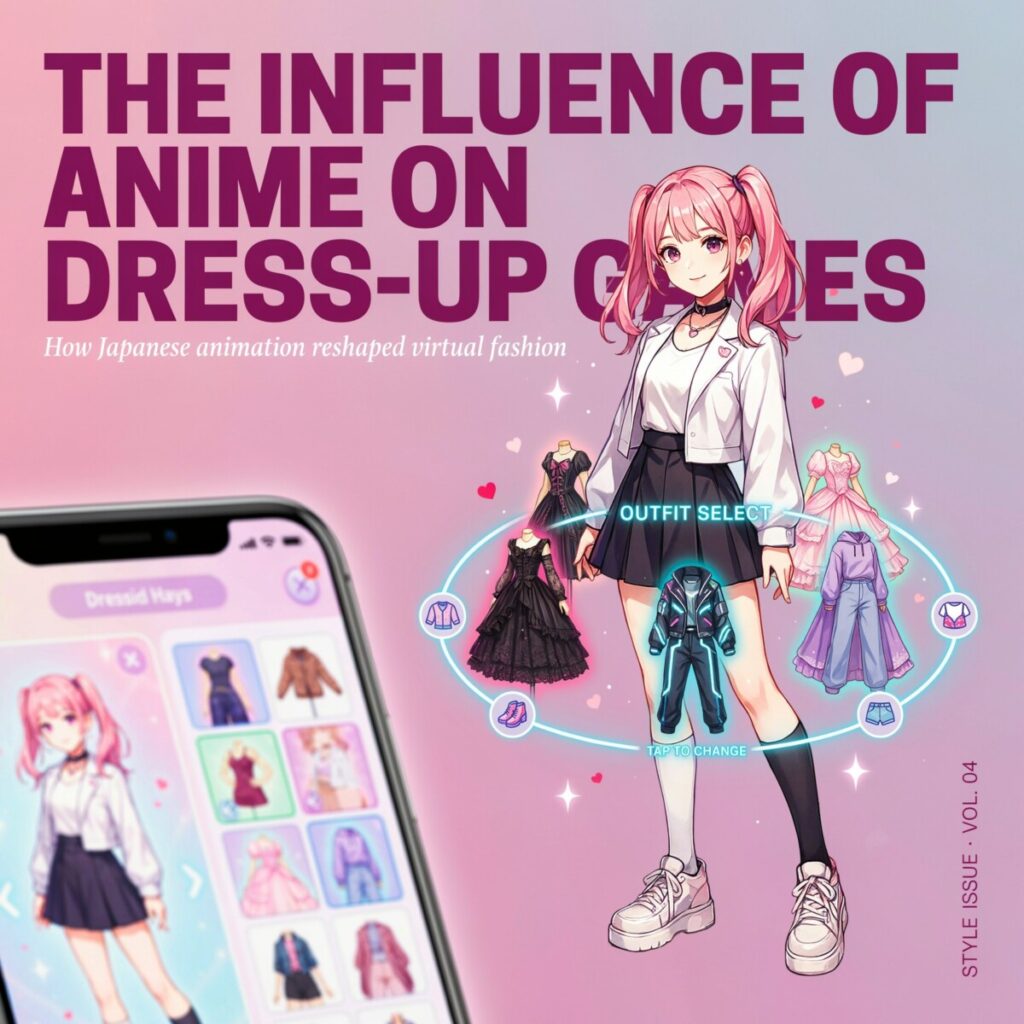
Anime’s visual signature is instantly recognizable, and it has become a default design pipeline for modern avatar customization systems. The hallmark traits—oversized expressive eyes, stylized hair with gravity-defying silhouettes, and carefully calibrated body proportions—create a visual shorthand that players immediately understand. Developers lean into these cues because they communicate emotion, status, and personality before a single word is spoken in chat. Whether a title opts for the adorable, rounded proportions of chibi avatars or the sleek, elongated lines of bishoujo and bishounen designs, the goal remains the same: instant visual readability paired with high emotional resonance.
When translated into interactive character design, these traits dictate everything from mesh topology to texture resolution. Clothing items often feature exaggerated draping, sharp color blocking, and deliberate layering that mimics traditional 2D cel-shading. Facial rigs are built to support wide, anime-style eye movements and highly articulated mouth shapes. Even idle animations loop with the rhythmic, slightly exaggerated pacing you’d expect from a keyframe animator working on a seasonal OVA. These design choices aren’t arbitrary; they directly impact how players perceive rarity, value, and personal expression within a virtual space.
Platforms like Dress to Impress Roblox have mastered this pipeline by offering highly modular outfit systems that blend anime aesthetics with contemporary streetwear. Players mix oversized blazers, pleated skirts, and gradient-dyed hair with precision-tuned accessories, all rendered in a clean, stylized art direction that prioritizes silhouette clarity. Mobile dress-up apps like Life Makeover and Love Nikki-Dress UP Queen push this further with physically simulated fabrics, dynamic lighting, and anime-inspired facial sliders that let players fine-tune everything from lash thickness to cheek blush intensity. Even browser-based dress-up communities continue to thrive by using lightweight vector rendering and crisp line art to deliver fast, highly customizable anime fashion experiences without heavy hardware requirements.
For content creators and marketers, this visual language drives shareability. When an outfit reads clearly in a 15-second clip or a static thumbnail, it converts. Color palettes are deliberately chosen for contrast and emotional tone, while emote systems rely on snappy, frame-by-frame animations that mimic anime acting tropes. The result is a character design ecosystem where every slider, texture, and animation loop serves both aesthetic appeal and functional engagement.
Narrative & Role-Play Mechanics
Visuals draw players in, but storytelling keeps them logged in. Anime dress-up games rarely exist as isolated styling simulators; they’re wrapped in narrative frameworks that borrow heavily from established genre tropes. School life arcs, magical girl transformations, idol training cycles, and fantasy questlines provide ready-made scaffolding for in-game events. Developers use these templates because they’re culturally familiar, highly adaptable, and naturally encourage repeat playthroughs.
Seasonal in-game events frequently mirror anime release calendars and cultural moments. A spring festival might trigger a cherry blossom-themed styling challenge, while a winter update could unlock a cozy academy storyline with NPC mentors that guide players through outfit curation. These scenarios aren’t just cosmetic backdrops; they dictate gameplay progression, unlock paths, and social ranking systems. Players don’t just dress for style; they dress to participate in a shared narrative that rewards consistency, creativity, and community engagement.
Virtual cosplay and role-play mechanics thrive in this environment. When players adopt anime archetypes, they step into predefined social roles that come with built-in interaction loops. A magical girl might join a guild-based crafting event, while an idol trainee participates in rhythm-based styling contests where timing and theme accuracy matter. NPC characters are designed with anime-style dialogue pacing, complete with catchphrases, tiered relationship meters, and branching quest paths that respond to outfit choices. This narrative layering transforms passive customization into active world-building.
From a retention standpoint, these mechanics are highly effective. They create natural content calendars, encourage player-generated storytelling, and give communities consistent touchpoints to gather, compete, and collaborate. When developers align update schedules with anime broadcast seasons or cultural holidays, they tap into existing audience momentum. The result is a self-sustaining cycle where narrative engagement drives styling participation, which in turn fuels social sharing and long-term loyalty.
Fashion Trends and Crossovers
Real-world fashion and virtual wardrobes have always influenced each other, but anime has accelerated that feedback loop into a highly visible cultural engine. Subcultures like Harajuku style, kawaii streetwear, and Lolita fashion originated in physical spaces but now thrive as digital-first aesthetics. Dress-up games adapt these trends by breaking them down into modular components that players can mix, match, and personalize. Pleated skirts, platform boots, pastel layering, and oversized outerwear become digital assets that reflect both historical fashion movements and contemporary internet culture.
Anime collaborations have turned these adaptations into high-impact marketing events. When a popular series licenses official outfits for a dress-up platform, the result is an immediate spike in engagement, social shares, and in-catalog conversions. Limited-edition drops create urgency, while fan-made inspired items keep the momentum alive long after the official campaign ends. This crossover dynamic works both ways: real-world brands monitor in-game fashion trends to identify emerging color palettes, silhouette preferences, and accessory combinations before bringing them to physical retail.
The cycle between fandom fashion and in-game trends is remarkably tight. Players who follow anime series often recreate iconic looks using available digital pieces, then share those creations across TikTok, Instagram, and Discord. Designers and indie developers watch those shares to identify which combinations resonate, then build official or semi-official variants that feed back into the game economy. This continuous loop ensures that anime-inspired fashion never feels static; it evolves alongside viewer expectations, seasonal releases, and community creativity. For digital marketers, this represents a highly efficient trend-spotting pipeline that operates in real time.
Monetization & Economy
Anime aesthetics don’t just drive engagement; they power highly structured virtual economies. The emotional attachment players form with stylized characters naturally translates into willingness to invest in digital fashion. Developers leverage this through cosmetic microtransactions, seasonal drops, and collectible systems that reward both spending and playtime. Limited cosmetics create scarcity, while tiered pricing allows casual players and hardcore collectors to participate at different levels.
Gachas and loot boxes remain controversial but undeniably effective in anime-driven environments. The randomized reveal mechanic mirrors the collectible culture of trading cards, blind box figures, and limited-edition merchandise that fandoms already understand. When paired with transparent pity systems and clear drop rates, these mechanics can drive consistent revenue without alienating players. Fandom-driven cosmetics thrive because they tap into identity expression rather than pure gameplay advantage. Players aren’t buying power; they’re buying cultural alignment, visual rarity, and social status within a community.
To illustrate how this pipeline works in practice, consider a purchasable magical school uniform with detachable cape and sparkling emote. Developers would release the outfit in a limited seasonal window, pair it with a matching accessory set, and include a custom idle animation that triggers when equipped. The item would appear in a themed storefront bundle, offer a guaranteed drop after a set number of purchases, and unlock a matching profile frame that signals rarity to other players. This structure balances collectibility, visibility, and player satisfaction while maintaining ethical transparency.
The economic model works because it respects how anime fandoms already operate. Collectors value completeness, social proof, and visual distinctiveness. When developers align pricing structures, drop schedules, and reward mechanics with those expectations, conversion rates improve, refund requests decrease, and long-term player lifetime value increases.
Community, Mods, and Creative Expression
The true engine behind any successful dress-up platform isn’t its codebase or its marketing budget. It’s the community that builds, shares, and refines the experience. Anime fandoms are naturally organized around creative output, and that energy translates directly into user-generated content ecosystems. Players don’t just consume outfits; they design palettes, script emotes, build matching sets, and publish tutorials that teach others how to maximize customization tools.
Discord servers, TikTok channels, and YouTube creators have become the central hubs for this exchange. Roblox groups function as styling collectives where players vote on themes, pool resources for collaborative events, and trade limited items through structured marketplaces. Browser communities maintain curated galleries that archive rare combinations, while mobile platforms host creator programs that spotlight indie designers. This decentralized network ensures that content never stagnates and that new players always have a clear pathway to participate.
User-generated content also serves as a low-risk testing ground for developers. When a fan-made accessory or color scheme gains traction across multiple platforms, official teams can adapt those concepts into polished, balanced releases. This feedback loop reduces development risk, increases community goodwill, and creates a shared sense of ownership over the platform’s direction. For content creators, it also provides a steady stream of collaboration opportunities, sponsorship integrations, and audience-building pathways that align directly with their niche.
Cultural Considerations and Criticisms
As anime aesthetics become mainstream in digital fashion, conversations around representation, appropriation, and cultural authenticity have grown louder. Dress-up games sometimes pull visual cues from Japanese subcultures without acknowledging their origins, historical context, or cultural significance. This can lead to stereotyping, flattened aesthetics, and player fatigue when every seasonal update feels like a surface-level remix rather than a thoughtful integration.
Developers can navigate these challenges by prioritizing cultural appreciation over casual borrowing. Consulting cultural experts, diversifying character base options, and providing historical context for featured styles helps build trust with global audiences. Offering accurate terminology, crediting original subcultures, and avoiding caricatured designs ensures that anime influences enhance rather than exploit the communities they reference. When handled responsibly, cultural integration becomes a competitive advantage rather than a liability.
Conclusion and Future Outlook
Anime’s influence on dress-up games isn’t a passing trend; it’s a structural shift in how digital fashion is designed, shared, and monetized. From stylized character rigs to narrative-driven engagement loops, anime aesthetics provide a reliable framework for player retention, community growth, and virtual economy optimization. The crossover between fandom culture and interactive styling will only deepen as platforms mature.
Looking ahead, emerging technologies will accelerate this evolution. AI skin generation will allow players to describe anime-inspired outfits in natural language and receive instantly rendered variants. AR try-on features will bridge physical retail with digital wardrobes, while virtual idols will host live styling events that blend performance, fashion, and real-time interaction. Developers who invest in ethical design, transparent economies, and creator-friendly tools will lead the next wave of virtual fashion platforms.
For more deep dives into this space, explore our Dress to Impress outfit guides for styling breakdowns, check out our tutorial on how to style kawaii avatars for beginner-friendly tips, browse our rankings of the best anime dress-up mobile games to compare top platforms, and review our breakdown of Roblox avatar monetization tips to optimize your virtual economy strategy.
Which anime-inspired outfit has earned a permanent spot in your digital closet? Drop your favorite in-game looks, tag the creators who inspired your style, and share this post with a friend who’s still figuring out their virtual aesthetic. Let’s keep the styling conversation going.
