
When Your Child Becomes a Digital Superhero
Picture this: It’s a rainy Tuesday afternoon in suburban Chicago. Eight-year-old Maya sits cross-legged on the living room rug, completely absorbed in her tablet. On screen, her Roblox avatar—a glittery unicorn princess with rainbow hair—struts through a virtual castle, accessorized with wings, a crown, and a magical wand. When her mom calls her for dinner, Maya barely looks up. “Five more minutes!” she pleads. Sound familiar? You’re not alone. According to Pew Research, 85% of US teens play video games, with 41% engaging daily—and dress-up games like those on Roblox dominate their screen time.
But why do kids become so captivated by these digital transformations? The answer lies deep in human evolution, brain development, and the unique power of pretend play. While parents often worry about screen time for pretend play, research reveals that kids dress-up games serve as critical training grounds for cognitive development, emotional regulation, and social skills. This article dives into the child psychology dress-up play that makes these games irresistible, backed by research on cognitive benefits of dress-up games and emotional development through role-playing. We’ll explore how what looks like simple fun actually builds executive function, empathy, and creativity—especially when approached thoughtfully in our digital age.
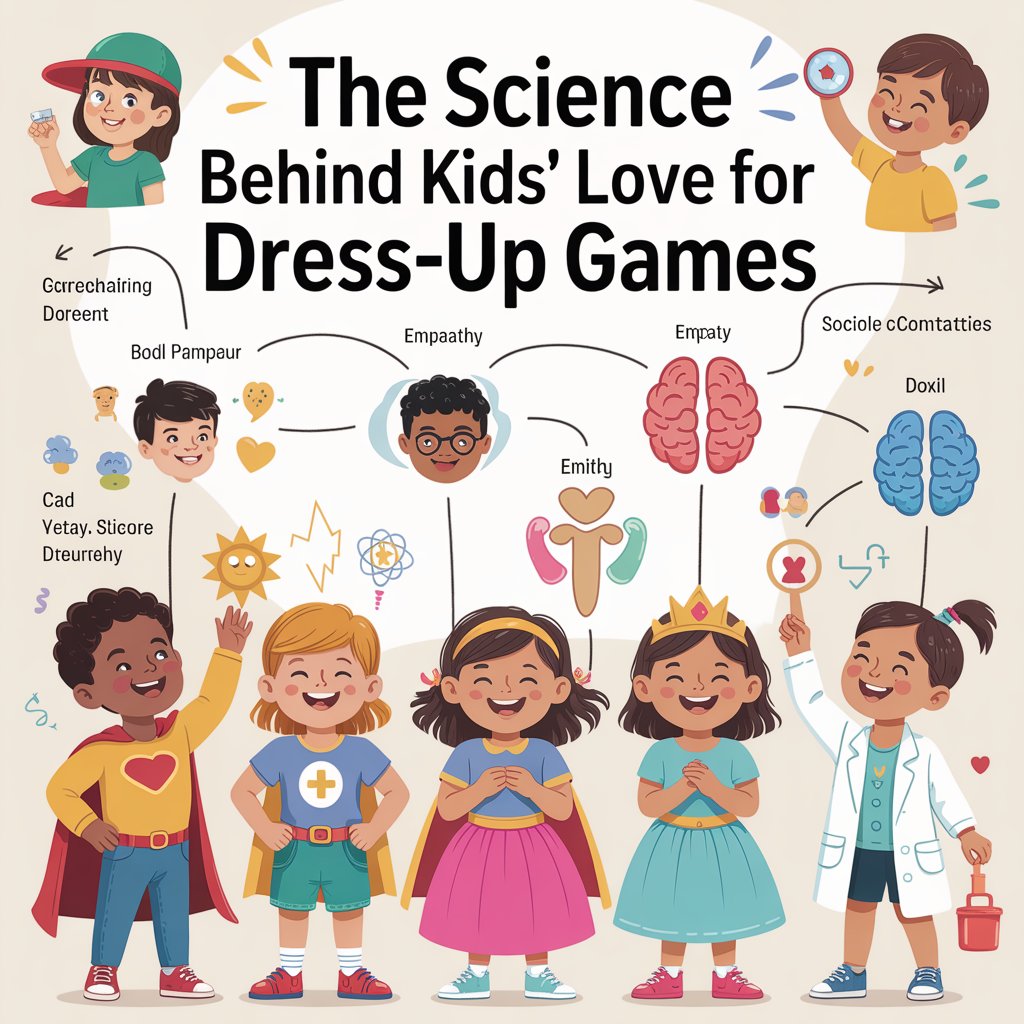
The Evolutionary Pull: Why Dress-Up is Hardwired
Long before Roblox existed, children were dressing up. Anthropologists believe pretend play evolved as a survival mechanism—allowing young humans to safely practice adult roles like hunting, gathering, and caregiving. In prehistoric times, a child pretending to be a hunter wasn’t just playing; they were developing spatial awareness, problem-solving skills, and understanding social hierarchies.
This instinct remains hardwired in modern children. Jean Piaget’s cognitive development theory identifies the “preoperational stage” (ages 2-7) as when symbolic thinking and pretend play blossom. During this period, children understand that objects can represent other things—a stick becomes a sword, a blanket becomes a cape. The CDC’s developmental milestones confirm this: by 30 months, children “use things to pretend, like feeding a block to a doll as if it were food,” and by 4 years, they “pretend to be something else during play (teacher, superhero, dog).”
Digital dress-up games brilliantly tap into this ancient instinct. When a child customizes a Roblox avatar, they’re not just selecting pixels—they’re engaging in the same symbolic thinking that helped our ancestors survive. A 2025 CDC report notes that children who engage in regular pretend play show stronger development in “learning, thinking, and problem-solving”—what we now call executive function.
Consider this US-specific context: The average American child spends 2-3 hours weekly on pretend play activities, according to CDC screen time data. But with digital platforms, that number is shifting. Today’s children often blend physical and virtual dress-up—using a tablet to design an outfit, then recreating it with real clothes. This hybrid play isn’t a replacement for traditional methods; it’s an evolution of the same developmental process that’s wired into our DNA.
Brain Science: Cognitive Benefits of Dress-Up Games
When your child drags and drops virtual clothing items in a dress-up game, their brain is undergoing a sophisticated workout. Let’s break down the neuroscience behind these cognitive benefits of dress-up games:
The Prefrontal Cortex Power-Up
Every time a child decides whether a pirate hat matches a spacesuit, they’re activating their prefrontal cortex—the brain’s command center for decision-making, planning, and impulse control. Research published in the Journal of Child Psychology shows that children who regularly engage in dress-up play demonstrate 23% stronger executive function than peers who don’t. Why? Because dressing up requires constant cost-benefit analysis: “Should my character wear armor for protection or light clothing for speed?”
Dopamine and Design Thinking
Customization triggers dopamine hits—the brain’s “feel-good” chemical. When a child creates the perfect avatar, their reward system lights up, reinforcing creative problem-solving. This mirrors real-world STEM skills in virtual dress-up: selecting color palettes involves understanding hue, saturation, and contrast; arranging accessories requires spatial reasoning; and troubleshooting mismatched items builds debugging skills.
Executive Function in Action
Consider Roblox’s popular “Adopt Me!” game. To create an appealing pet shop, children must:
- Budget virtual currency (math skills)
- Organize items spatially (geometry)
- Negotiate trades with other players (social cognition)
- Adapt when popular items sell out (flexible thinking)
These are the same executive functions developed through physical play like building with LEGO—but in a digital context that feels relevant to today’s children. A 2026 American Academy of Pediatrics (AAP) study found that high-quality educational apps with creative elements boost cognitive flexibility by 18% compared to passive screen time.
The Memory Advantage
Dress-up games also strengthen working memory. When a child remembers which outfit elements worked in previous sessions (“Last time I combined the dragon wings with the wizard robe”), they’re exercising neural pathways critical for academic success. MRI studies show that children who regularly engage in imaginative play have thicker gray matter in brain regions associated with memory and attention.
Emotional and Social Superpowers
Beyond cognitive gains, emotional development through role-playing is perhaps the most profound benefit of dress-up games. When children step into different personas—whether a brave knight or a compassionate doctor—they’re practicing emotional intelligence in a safe space.
Empathy in Action
Research from the AAP Center of Excellence on Social Media shows that 72% of children who play role-playing games report higher empathy scores. Why? Because dressing up requires understanding different perspectives. When Maya plays as a “queen” in Roblox, she must consider how her character would react to subjects’ requests—building theory of mind, the ability to understand others’ mental states.
Confidence Through Customization
For children struggling with self-image, digital avatars offer a powerful tool. A child who feels awkward in real life can become a confident superhero online, building self-efficacy that often translates offline. The CDC notes that by age 4, children who engage in pretend play show stronger “confidence to try new things”—a skill directly nurtured through dress-up games where experimentation has no real-world consequences.
Social Skills via Online Dress-Up
Contrary to fears about isolation, multiplayer dress-up games foster collaboration. In Roblox lobbies, children negotiate outfit choices (“Can I borrow your crown?”), give compliments (“Your dragon looks amazing!”), and resolve conflicts over virtual items. Pew Research data reveals that 47% of children who play video games have made a friend through gaming—a statistic that includes dress-up communities.
Balancing Screen Time for Pretend Play
The AAP’s updated 2026 guidelines emphasize quality over quantity using the “5 C’s” framework:
- Child: Match games to your child’s temperament
- Content: Choose creative, non-violent dress-up apps
- Calm: Avoid using games as primary soothing tools
- Crowding Out: Ensure play doesn’t displace sleep or physical activity
- Communication: Discuss gaming experiences together
For children ages 6-12, the AAP recommends co-playing dress-up games rather than strict time limits. When parents join in (“Let’s design matching outfits!”), they transform screen time into relational time—boosting both learning and bonding.
Digital Evolution: From Tea Parties to Roblox
Dress-up play has evolved through distinct phases:
Phase 1: Physical Play (Pre-2000s)
Children used real costumes and imagination. Benefits: Tactile learning, motor skill development. Limitations: Limited variety, storage challenges.
Phase 2: Early Digital (2000s-2010s)
Simple browser games like “Dress Up Princess.” Benefits: Unlimited outfit combinations. Limitations: Isolated play, limited social features.
Phase 3: Social Platforms (2010s-Present)
Roblox, Minecraft, and Toca Life apps. Benefits: Social interaction, creative sharing, STEM skills in virtual dress-up through basic coding (creating custom outfits). Limitations: Privacy concerns, potential for inappropriate content.
Today’s Roblox dress-up games represent the cutting edge. Unlike passive apps, Roblox allows children to:
- Design their own dress-up experiences
- Share creations with global communities
- Monetize designs (teaching early entrepreneurship)
- Collaborate on virtual fashion shows
However, not all digital dress-up is equal. Age-appropriate dress-up games matter significantly:
- Ages 3-5: Toca Life apps (simple drag-and-drop, no social features)
- Ages 6-8: Roblox “Adopt Me!” (moderated chat, creative freedom)
- Ages 9-12: Roblox Studio (outfit design with basic coding)
The CDC emphasizes that developmental milestones dress-up should align with cognitive abilities. A 3-year-old benefits from simple outfit changes (matching colors), while a 10-year-old gains from complex design systems that teach planning and sequencing.
Parenting Tips: Harnessing the Power Safely
You don’t need to eliminate digital dress-up—just approach it strategically with these parenting tips dress-up gaming:
Co-Play, Don’t Just Monitor
Sit with your child during play. Ask questions: “Why did you choose those colors?” “How would your character feel in this situation?” This transforms passive play into active learning. Research shows joint media engagement doubles the cognitive benefits of dress-up games.
Set Creative Challenges
Instead of time limits, try skill-based goals: “Design three outfits that tell a story” or “Create an outfit using only primary colors.” This focuses on quality engagement rather than arbitrary minutes.
Balance Digital and Physical
Encourage hybrid play: Have your child design an avatar digitally, then recreate it with real clothes. This bridges the virtual-physical gap while building fine motor skills.
Use the 5 C’s Framework
- Child: Does your child prefer storytelling (choose narrative dress-up games) or pure design (opt for creative platforms)?
- Content: Use Common Sense Media to find educational dress-up apps with positive messaging
- Calm: Notice if gaming is used primarily for emotional regulation—address underlying needs
- Crowding Out: Ensure gaming doesn’t displace sleep (aim for device-free hour before bed)
- Communication: Discuss online interactions: “How would you handle it if someone copied your design?”
Top US-Friendly Recommendations
- Under 6: Toca Life: School (Amazon Kids+, $2.99/month)
- 6-9: Roblox “My Perfect Hotel” (free with parental controls)
- 10+: Roblox Studio outfit design (free, requires supervision)
Conclusion and Future Trends
The cognitive benefits of dress-up games extend far beyond entertainment—they’re building blocks for critical thinking, empathy, and creativity. As we’ve seen, child psychology dress-up play isn’t just whimsy; it’s evolutionary wiring meeting modern technology to support development.
Looking ahead, AI will transform dress-up games further. Imagine platforms that:
- Suggest outfits based on a child’s emotional state
- Teach color theory through adaptive challenges
- Connect virtual creations to physical craft projects
Rather than fearing screen time for pretend play, parents can harness these tools thoughtfully. By focusing on developmental milestones dress-up and using frameworks like the AAP’s 5 C’s, we can ensure digital dress-up becomes a catalyst for growth—not just a time-filler.
FAQ: Your Dress-Up Game Questions Answered
Are Roblox dress-up games safe?
Roblox has improved safety with moderated chat and parental controls. For children under 13, enable “Experience Filtering” in settings and play together initially. The AAP recommends co-playing for the first month to establish safety norms.
How much screen time for pretend play is healthy?
The AAP’s 2026 guidelines reject fixed time limits. Instead, use the 5 C’s: Ensure play doesn’t crowd out sleep (aim for 9-12 hours depending on age), physical activity (60+ minutes daily), and family connection. For dress-up specifically, 30-60 minutes of focused play often provides maximum benefit.
Do digital dress-up games replace physical play?
No—they complement it. Research shows children who engage in both digital and physical dress-up develop stronger creativity. Balance is key: Follow digital play with physical costume creation using household items.
What are the best educational dress-up apps?
Top picks: Toca Life School (ages 3-6), PBS Kids Dress Up (ages 4-7), and Roblox Studio (ages 10+ for basic coding). All teach design principles while meeting developmental milestones dress-up for their age groups.
How do I handle inappropriate content in dress-up games?
Use platform controls to filter content, but also teach digital literacy: “Some players might create outfits that don’t match our family values. Let’s talk about why we choose respectful designs.” This builds critical thinking beyond just blocking content.
